Home / Rheal Software Blog / Revolutionizing Claims Assessment: The Game-Changing Role of Drones in Property Damage Evaluation
Revolutionizing Claims Assessment: The Game-Changing Role of Drones in Property Damage Evaluation
Published on March 18, 2024
Introduction
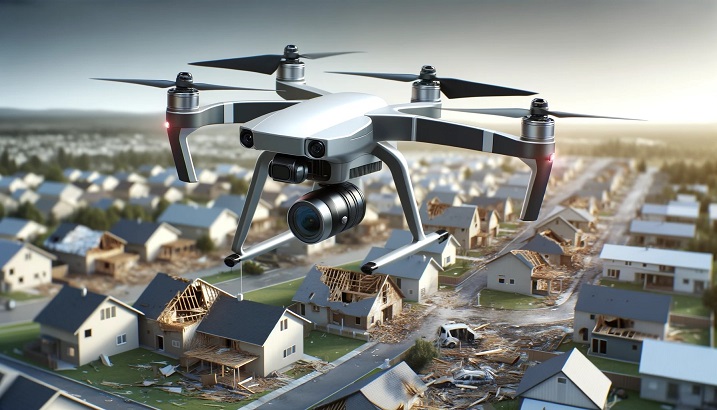
In recent years, the insurance industry has witnessed a transformative shift in property claims assessment, courtesy of an innovative player: drones. These unmanned aerial vehicles (UAVs) are reshaping the landscape of damage evaluations, especially following natural disasters. This blog post explores the burgeoning role of drones in property claims assessments, highlighting how aerial imagery and data collection are not only expediting the process but also significantly enhancing its accuracy.
1. The Emergence of Drones in Insurance Assessments
In the aftermath of natural disasters like hurricanes, earthquakes, or floods, assessing property damage can be a daunting task. The advent of drone technology has offered a cutting-edge solution. Drones, equipped with high-resolution cameras and advanced sensors, provide insurance companies with a new vantage point. This section will explore how drones came into play in the insurance world and their impact on post-disaster assessments.
2. Aerial Imagery: A New Perspective on Damage Assessment
One of the most significant advantages of drones is their ability to capture detailed aerial imagery. In this segment, we delve into how these images are revolutionizing property damage assessments. From offering a bird's-eye view of inaccessible areas to capturing extensive property details, aerial imagery is a game-changer. We'll examine case studies where drone imagery provided crucial data in the wake of natural disasters.
3. Enhanced Data Collection and Analysis
Drones don't just capture images; they collect a wealth of data. This part of the blog will discuss the types of data drones gather, including 3D mapping, thermal imaging, and structural assessments. We'll explore how this data is used to create detailed, accurate, and comprehensive property damage reports, aiding insurers in making informed decisions swiftly.
4. Speed and Efficiency in Claims Processing
Time is of the essence in post-disaster scenarios. Here, we'll assess how drones are accelerating the claims process. By swiftly accessing and assessing damaged areas, drones reduce the time taken for claims processing from weeks to mere days, or even hours. This section will include testimonials from insurance professionals and clients who have experienced the expedited process firsthand.
5. Accuracy and Precision: Reducing Human Error
Human assessments are susceptible to errors and inconsistencies. Drones, on the other hand, offer a level of precision previously unattainable. This portion of the post will focus on how the accuracy of drone assessments is minimizing disputes and errors in claims, leading to fairer outcomes for policyholders.
6. The Future of Drone Technology in Insurance
Looking ahead, what does the future hold for drone technology in claims assessment? This concluding section will explore upcoming innovations in drone technology, such as AI integration and autonomous flight capabilities. We'll also discuss the potential challenges and regulatory considerations that come with the increased use of drones.
7. Reducing Costs and Enhancing Customer Satisfaction
The deployment of drones in claims assessment is not just about efficiency and accuracy; it's also about cost reduction and customer satisfaction. Drones eliminate the need for costly and time-consuming manual inspections. This section will explore how the reduced operational costs translate to savings for both insurance companies and policyholders. We'll also discuss the impact of quicker claim resolutions on customer satisfaction, highlighting feedback from policyholders who have experienced the streamlined process.
8. Improving Safety for Claims Adjusters
Traditionally, claims adjusters often faced hazardous conditions while assessing property damage, especially in areas hit by natural disasters. Drones are changing this by allowing adjusters to conduct assessments remotely. This part of the article will delve into how drones are enhancing the safety of claims adjusters, reducing the need for them to enter dangerous or unstable areas, and the positive impact this has on the overall claims processing workflow.
9. Navigating Legal and Privacy Concerns
With the increasing use of drones in property claims assessments, there are emerging legal and privacy concerns that must be addressed. This segment will cover the current regulatory landscape governing drone usage, focusing on privacy laws, airspace regulations, and the need for compliance. We will discuss how insurance companies are navigating these challenges while ensuring ethical and lawful use of drone technology.
10. Case Studies: Success Stories in the Field
To bring the discussion to life, this section will present real-world case studies where drones made a significant impact in claims assessment. We'll look at specific instances of natural disasters where drones were deployed, detailing how they aided in the rapid and accurate assessment of damages, and the tangible benefits realized by both insurers and policyholders.
11. Training and Skill Development for Drone Piloting in Insurance
As drones become more prevalent in claims assessment, there is a growing need for skilled drone operators. This part will examine the training and skill development initiatives being undertaken by insurance companies. We'll explore the certification processes, ongoing training programs, and how these efforts are ensuring that drone operations in claims assessments are conducted by proficient and knowledgeable professionals.
12. The Environmental Impact of Using Drones
Lastly, the environmental aspect of using drones in claims assessments cannot be ignored. This section will highlight how drones, being an eco-friendly alternative to traditional methods, are reducing the carbon footprint associated with property claims assessments. We will discuss the sustainability benefits of using drones, contributing to the broader environmental goals of the insurance industry.
Conclusion
The integration of drone technology in property claims assessments is a clear testament to how technological advancements can revolutionize industry practices. From increasing efficiency and accuracy to enhancing safety and customer satisfaction, drones are setting a new standard in the insurance sector. As we move forward, the continued evolution of drone technology promises even more significant impacts, shaping the future of claims assessment in profound ways.
ABOUT THE AUTHOR


RELATED ARTICLES

Blockchain in Insurance Revolutionizing Property and Liability Coverage
Explore how blockchain technology is revolutionizing property and liability insurance, offering solutions to challenges such as fraud, inefficiency, and lack of transparency.

Claims Automation and Artificial Intelligence Revolutionizing Property and Casualty Insurance Processes
Explore how the integration of Artificial Intelligence (AI) and automation is reshaping the landscape of property and casualty insurance, enhancing efficiency, precision, and reducing claims processing time.

Predictive Analytics for Claims Management: Transforming Property and Casualty Insurance
In the dynamic world of insurance, predictive analytics and machine learning are becoming essential tools for transforming property and casualty insurance claims. Explore how these technologies are reshaping risk evaluation and claims processing efficiency.

Chatbots and Customer Service: Revolutionizing the Insurance Industry
Explore the transformative impact of AI-driven chatbots in the insurance sector. These innovative tools are reshaping customer interactions, setting new standards in efficiency, and enhancing overall satisfaction.

Revolutionizing Claims Management: The Role of Robotic Process Automation (RPA) in Claims Communication
Explore the transformative impact of Robotic Process Automation (RPA) in claims handling, specifically in property and casualty insurance. Witness how RPA revolutionizes communication within the claims management process.

Climate Change Impact on Property and Casualty Claims: Navigating New Risks with Technology and AI
Explore the profound influence of climate change on property and casualty insurance claims, examining how emerging technologies, especially artificial intelligence (AI), play a pivotal role in assessing and managing evolving risks.
If You Are In Need of a Reliable Outsourcing Partner, Try Our Services Risk Free!
- Start with a free no obligation consultation to discuss your business needs.
- We will advise you on how we can help you. You can then try our services risk free for a 100 hours.
- Pay only if you are satisfied. Otherwise, you owe us nothing, no questions asked.





Thank you for submitting your inquiry for our 100 hour Risk Free Trial.
We will get back to you shortly.
Please try again.